Showing posts with label cut. Show all posts

April 21, 2019

April 7, 2019 Cut Plan

So I've been cutting for several weeks now and wanted to write about what I'm doing this time around.   I've mentioned before that people grossly over-estimate how much protein they need; I believe I linked to a study showing that around 140g you reach nitrogen balance, and 160g being peak protein synthesis.  Past that there's diminishing returns for each gram you ingest   So last summer on off-days I kept it around 140, and on workout days I was around 180.  I ate a bit more on my workout days than in the past as well.  As for exercises, I added in 400m sprints.  

The results were decent, but left me wanting more.  First, as far as diet goes, getting 140g of protein the day after a savage workout isn't really conducive to progress. I did hold on to strength better through the cut but I think that was more a product of eating more on the workout days.  I also feel like while the 400s were decent, it's just so different than 100s that it just made me decent but not great at either.  The 400 is something you really need to plan your training around, and it's pretty much the opposite of what I'm going for with all the other stuff I do. 

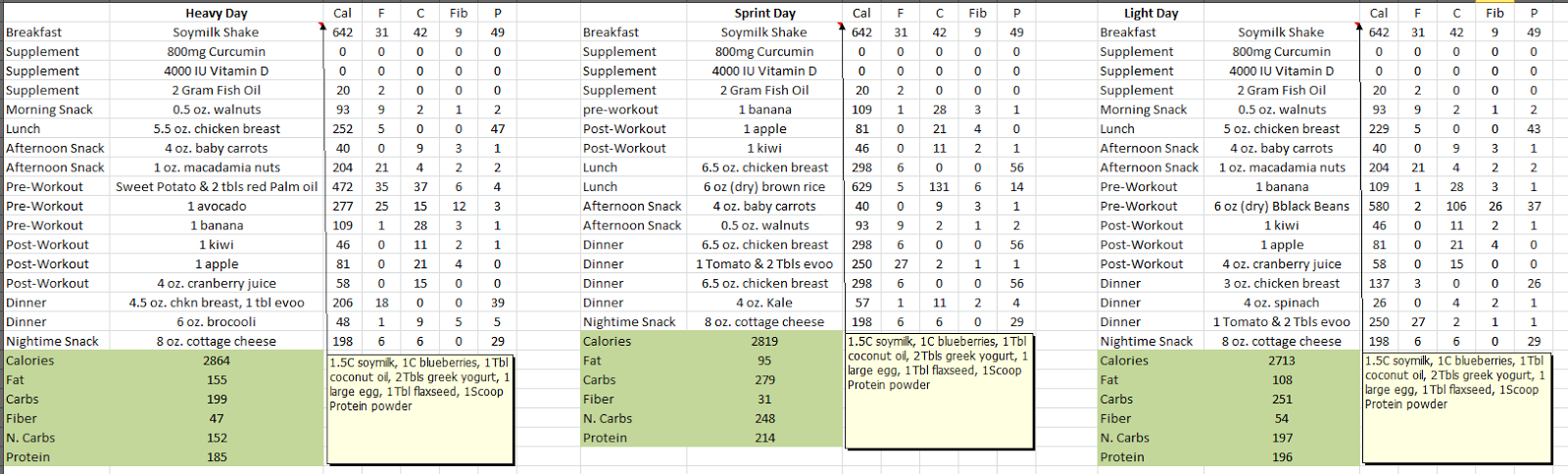
So this year I'm going to focus on 100s at the track again (and some 200s).  I'm upping protein across the board, trying for 190+ on workout days, and 180 on non-workout.  Even if there's diminishing returns past 160g or so for most people, it's still a return.   I'm also going to be posting screen shots of my nutrition log for the coming week to give a sense of what I'm doing. 

November 19, 2015

2015 Progress Pics!

Last November I took a bunch of pictures after what was probably my most successful cut, and realized I was really happy with where I was.   For this past year my main goals were to add a bit of muscle, particularly lower body, to continue my improvement in the 100m & 200m. I also play football, usually at corner, as I've noted here.  So over the past year I was pretty successful, I'm 4.5 lbs. heavier in the 2015 pictures; about 194 lbs.  The changes aren't dramatic, but my legs are leaner, but with more muscle, and my upper body also looks way thicker; you can see a difference in the side-shoulder picture.   Plus I finally have a picture where my jaw isn't hanging open or something so I could leave my face in. My ass was probably the biggest improvement, but I'll spare everyone those pictures.  Also, this might be the most vain thing I've ever said (quite an accomplishment) but I love having that vein visible on my left hip.

It's been a great year, and honestly I'm not slowing down in the least; these pictures were from about a month ago, October 10th-ish, so I'm 34 in them (I'm going to write about getting older, soon).  I don't notice anything sagging, my recovery times are the same as always, and my strength hasn't tailed off in the least.  Overall I'm really happy with how things have gone.  Now on to the pics:


December 18, 2014

December 18, 2014 Progress Pics!

I realize I haven't taken progress pics with my actual SLR in ages, maybe ever. I took a ton back at the start of November at the end of the cut. Click for larger versions. Here they are:


First probably the best shot in the batch, then 4 more that I used to show overall development. I tried to get some leg shots from varying angles to show progress there. VERY happy with these shots. 


A few back shots:


Front 
Note: I don't have a palsy or anything, I just kept fucking up trying to take the picture and got sick of trying repeatedly.  I have a bunch of shots where my left shoulder is the higher one.  


Lastly a couple bonus shots, one showing glute development. The second...I have no idea..but check out the muscle on my hip. I have no idea what that is. 


August 13, 2014

August 8, 2014 Progress Pics


So I took some progress pictures of my back....holy crap.  I love ECA. This is by far the largest and most cut I think my back has ever been.  VERY happy with these results.  


I'm not sure what I'm doing here...:
\

Finally some rare pictures showing face


So yeah, I'm loving the ECA cut. 

May 26, 2014

2014 Cut Plan

Alright, so here we go. So I've been happy with my cuts in previous years, and I've posted results from them showing they went well. But I always feel like I can improve on it, hence the massive amount of research I did this year.  Several factors influenced my choices and I covered them earlier.  The first and foremost of which was eating to match what I'm doing. Last year (and every year really) I usually alternated high-carb and low-fat days, without much thought as to which went where.  This makes no sense.  My usual days of low rep high weight type work isn't really depleting any glycogen, yet I would load up on carbs later in the evening, and barely any fat.  Again, not the end of the world, but wasn't really letting me progress.  Your body also needs fat for maintaining hormone levels, and while I don't recall anything specific to make me think I wasn't, there are a ton of health benefits from things like EVOO, Coconut Oil, and Red Palm Oil among others, and I was missing out on a lot of them several days per week.  Finally, your bodies' preference for using dietary fat to fuel metabolism played a factor as well, along with my hope was to avoid losing much, if any strength this cut (more on this in a moment).  

Having decided on that, I also didn't want a repeat of last year, when on my high-fat days I was probably close to 70g of polyunsaturated fats. Having read up and digested a great deal of information on the topic, which I summarized here for you.  I want to keep it closer to 15g-20g this time around (I didn't quite get there, but I'm in range; I'll get closer if I swap out soy milk which has a ton of polyunsats, with regular milk, if I ever find a good local source).  

Finally, as I noted, you don't need nearly as much protein as you think you do. I was somewhere between 225 and 250g per day last year, and a bunch of that was probably just getting converted to ammonia in my blood. No more of that.  I have it capped a little over 210 on my sprinting days which are brutal, and then around 185-190 on my other days.  Oh, and regarding fructose, I'm not that worried as my levels aren't that high this time around.  I was probably close to 60g last cut on my high-carb days, not repeating that. This time I'm in the mid 30s, which is fine considering most of it is post-workout, which negates a lot of the issues with it.  In the previous link I also talk about insulin sensitivity some, and note that between 100 and 200g carbs per day leads to the greatest amount of insulin sensitivity. 

OK, enough talk, here's what I'm going with this time around:


On my heavy days when I'm doing the low rep stuff I'll be getting about half my cals from fat, 25% from carbs, 25% protein, for the reasons stated above.  On sprinting days I knock the fat back a bit and up the carbs a good deal; by the end I'm depleting glycogen like crazy, especially on the 200s.  I also bump up the protein because of how much damage I'm inflicting on my posterior chain. On my 'light' day in the gym, which would be things between 5 and 8 rep sets, I'm going to be around 200g of carbs net, lower fat, and slightly higher protein since I'm inflicting a bit more muscle-trauma than on the heavy days.  Here's how things like PUFAs (and omega-3s & oemga-6s), and fructose shook out, as well as what my targets were for each day for macros:


I got pretty close to what I wanted, and will get closer on PUFAs when I switch off of soy milk.  Also, at the moment I'm at 1 oz. walnuts, no macadamia because I'm trying to find a cheaper source, they're expensive. 

One final note:  to speed up the cut I've cut the fat back from the levels here, I do either an avocado or the sweet potatoes on the heavy day, bringing me back to either 2200 or 2400 calories.  As I get closer to my goal weight/comp I'll bring both back in.  That's what I like about using so many oils here, if I need to cut back on calories later I can just reduce tablespoons of the stuff.  


The results so far? Good. Really good. I'm down from 230 to about 210-212 right now. I've barely lost any strength, maybe none even.  The shoulder tweaking prevented me from push pressing and snatching heavy for a while, but even there I haven't really lost a ton of strength.  Squat, deadlift, benching, rows, all of it feels good.  I look pretty good too, I'll post progress pictures soon.  Another few weeks I should be really close to where I want to be, and I'm going to start running Hot-Rox soon (more on that in another post). Alright, I've rambled enough. 

March 20, 2014

2014 Cut, Part IV: Carbs and Fructose

So this is part 4 of my spring cut monster blog.  This is more a loose-ends before I post the actual diet/numbers I'm going to be running, but it's got some points regarding grains, carbs, and fructose. I’ve mentioned this before, but it’s worth mentioning again Grains are just not good for you; I know, I know, the cereal aisle is full of whole-grain goodness.  Well, whole-grain cat shit is still just cat shit.  I could write a whole separate 2,000 word piece on why grains are not good for you.  Things like gluten intolerance are experienced by pretty much everyone, but those with more prevalent forms will get the label. However everyone has an inflammatory response to grains. So those are still out. I may have them on fat-kid Saturday, but they continue to not have a place in my diet.  Humans are just not meant to consume them. Period.  Again, you have a ton of government subsidies pushing “healthy whole grains” or “heart healthy whole grains” [you can actually buy the American Heart Association endorsement by the way, it’s not based on science], just like you do with PUFAs.  It’s what’s cheapest for us to produce, so it gets pushed.   But I digress…

Fructose is another issue I’ve been thinking about and researching.   There is some evidence that beyond 25G of this per day can begin to cause toxicity in your body  and it is associated with fatty liver disease as well.  Now granted it’s probably better than mainlining cheeseburgers, but still.  Roughly half of the carbs in fruit like apples/kiwis comes from fructose.  Also, sucrose gets broken down in the liver to 1 part fructose and 1 part glucose, so that 25g comes from fructose, and half of the sucrose intake for a day.  Intense exercise can help raise this threshold, as it depletes liver glycogen and any fructose that makes its way there is promptly converted to glycogen.  My main concern is that sugar, particularly fructose, oxidizes LDL into pattern B (the smaller, much more lethal form of LDL).  1 medium apple contains about 11g of fructose in it, as well as another gram and a half from the conversion of sucrose.   Again, I’m not cutting out fruit obviously, but a couple apples per day and a couple bananas (bananas are actually slightly better since only about 1/3 of their calories comes from Fructose) is probably overkill. I will probably go back to 1 each per day, and carry on as usual with my other fruits/fruit juices. I’ll replace the calories from fewer bananas/apples with vegetables, and probably try to stick to around 35-40g of fructose on my high carb days.  

Also, another consideration, when I look at carb numbers, I’m looking at net from now on.  Shouldn’t be a huge difference, but it’s probably come up before.  Soluble fiber may give you one calorie in the gut after the bacteria that live off it digest it, but that’s negligible.   I’m also going to get more calories from red palm and coconut oil, both are healthier sources of fat. Coconut for instance is a medium-chain fatty acid and is processed more like a carb for energy purposes, just without the accompanying insulin spike.

2014 Cut, Part III: Fats, "Healthy Fats", Omega-3 Myths

So part 3 here will be dealing with fats, healthy fats, and sources of fats particularly Polyunsaturated Fatty Acids (PUFAs). You probably are more familiar with PUFAs as Omega-9, Omega-6, and Omega-3 fatty acids among other things.  There is about two decades of evidence that points to Polyunsaturated Fatty Acids (PUFAs) as being the main culprit in heart disease, cancers, and high cholesterol.   High cholesterol may actually be a reaction to damage caused by PUFAs to blood vessels, which then seek to reinforce themselves with cholesterol, but that particular point is still in its nascent phases of being researched.    You may be thinking that saturated fats are horrible for you, and yes, sometimes, in certain things they are.  Industrial corn-fed beef? Yup, probably horrible for you.  But PUFAs are implicated in a growing number of health issues.  There have actually been several studies comparing saturated / monounsaturated /omega-6s and their effects on heart health.  In one, people suffering from chronic heart disease had their diets supplemented with either saturated animal fat, olive oil, or High omega 6 oils (corn I believe). In several years, the saturated animal fasts group had the fewest deaths, the olive oil group was second and the omega-6 group had the most. The heart related deaths were about the same but the omega-6 group had 3 times the cancer deaths; if accounted for that would have shown that the rate of CHD deaths in that group actually greater. The conclusion of the researchers? CHD patients weren't good subjects for testing the healthiness of fatty acids. Incidentally they actually stopped the study early on account of their fears that cancer deaths were going to explode in the omega-6 group.

So are Omega-3s healthy? To an extent; they’re a mixed bag really. Here's a great study showing the good and bad.  I’m not saying PUFAs should be entirely cut out, but rather limited, quite a bit.  They do serve a purpose; your body needs some.  But the problem is there are so many recommendations out there now that push the idea of mega-dosing fish oil, and the scientific data just does NOT backup this recommendation in any way shape or form.  What gets lost is that a lot of the Omega-3 benefit comes from the fact that it helps balance out the excessive Omega-6 intake of most individuals. Put another way: Omega-3s are not great for you either, but they’re less bad than Omega-6s.   This does not mean however, that loading up fish oil, or any omega-3 is a good idea.  As the previous link notes, there actually haven’t been any studies on the long-term effects of fish oils (or omega3s) and the mid-range studies actually find increased mortality among users.  This is most likely because Omega-3s are heavily oxidative.   You’ve heard of anti-oxidants most likely; these compounds protect against oxidative damage to proteins, tissue, and DNA.  There are many oxidative compounds, and Omega-3s are actually worse than Omega-6s.  The reason for this is that the chemical composition of Omega-3s contains a backbone with several double carbon bonds which are highly unstable, and the breakdown of which causes oxidative damage, particularly to the linings of blood vessels, and which can also be carried into cells, damaging them as well. In the linked picture the "=" between the C's represents a double bond, in Linolenic acid.   Saturated fat contains none of those double-bonds, and monounsaturated contains one double-bond. There is evidence that among those who recently suffered a heart attack, supplementing with fish oil may help prevent death via arrhythmia.  However, there is no evidence showing any long-term benefit of supplementing with fish oil (or any omega-3 for that matter). So how did Omega-3s/PUFAs end up being the ‘savior’ compared to ‘evil’ saturated fats?  General government laziness of all things. More on that in a bit.

Now, before you go and flush all your fish oil, again, you do need some PUFAs/omega-3s/omega-6s.  But as shown, the typical American diet gets way too much PUFAs overall, and way too many 6s.  Men in particular have it bad, as another issue with Omega3s is that men need more DHA than EPA, but in most fish-oil supplements it’s actually flipped; Biotest’s Flameout being the exception that I can think of.  So all things in moderation, including PUFAs.  Research shows that Probably 15g total of PUFAs is the upper limit before you start running into issues (with about 10 from Omega-6s and 5 from Omega-3s).  I was getting closer to 40 on my high fat days last cut; which won’t be happening again.  The message here is moderation, things like walnuts are not bad for you, but look at it this way: the omega-6 to omega-3 ration in them is 5:1.  Human-beings should be around 1:1 or 2:1; I think there is the assumption that because a food has a ‘healthy’ reputation that you can overlook the actual composition of it.  This goes for any food; but in this particular case here is a link sums up my feeling on PUFAs pretty well.   So sticking with the walnut example; while they are a healthy food relatively speaking, you can’t ignore the fact that it’s got a ton of omega-6s when planning out how you eat.  In other words, include walnuts in your diet, they have many great features, but don't go hog-wild with them.  As per omega-3s, most of the studies that show benefits are very short term, and focus only on direct supplementation with just fish oil, or just omega-3s in pill form.  I’m going to pinch a quote from Kuipers et al. that appears in one of the earlier links, but really summarizes any supplementation study:

The fish oil fatty acids EPA and DHA (and their derivatives), vitamin D (1,25-dihydroxyvitamin D) and vitamin A (retinoic acid) are examples of nutrients that act in concert, while each of these has multiple actions(7,8).
Consequently, the criteria for establishing optimum nutrient intakes via randomised controlled trials (RCT) with single nutrients at a given dose and with a single end point have serious limitations. They are usually based upon poorly researched dose–response relationships, and typically ignore many possible nutrient interactions and metabolic interrelationships.

So what about saturated fats then, and red meat as a source in particular.  People often associate red meat with death via saturated fat.  The problem with most red meat (and any farm food really), is the quality and where it came from. The average ground beef or red meat in the grocery store was likely fed corn, grains (making the animals super fat and unhealthy), antibiotics, hormones that are illegal in other countries, and the animal got no exercise, and is filled with preservatives. Organic, grass fed, free range beef is the closest thing we can get to being completely natural, the animals are fed what they're meant to eat, get exercise and are healthy. So, if you can get the good quality meat, you can probably eat it more consistently (All of this also goes for dairy; I like cottage cheese, and my shakes typically contain milk, but I have no idea where it’s been coming from, I'm hoping to change that).  But currently federal guidelines push things like omega 6s (think of virtually every vegetable based cooking oil) because it’s actually better than added sugar, and this of course ignores that we’re really talking about worst and 2nd worst.  So foods can actually brag about their omega-6 oil laden products being healthier because they have no sugar.  You'll die of diabetes, general obesity, cancer, or some other awful disease, but hey, at least you didn't get any saturated fat! 

As an appendix, here is a list of foods and their Omega-3:Omega-6 ratio. 

March 19, 2014

2014 Cut, Part II: How Much Protein do You REALLY Need?

This is part 2 in my series on factors that went into determining this cut, and that hopefully others can use in determining their own cutting (or bulking) or just general nutritional needs.

I’ve known for a while I probably end up eating more protein than I need. You don’t need nearly as much protein as you probably think you do.  Additional protein past your needs actually causes an increase in enzymes that aid the use of protein breakdown for energy, and can be counter-productive. Here's a great study on the topic. Basically what was found is that even heavily trained athletes achieved nitrogen balance around 0.7g per pound of bodyweight, so around 140g for a 200 lbs. person.  Furthermore, maximum additional synthesis occurs about 25% above balance, so about 170g for a 200 lbs. person.   Not only that, but beyond the point of reaching nitrogen balance ammonia started to build up at an increasing rate in the subjects’ systems. Past about 230g every single gram of protein was converted entirely into ammonia (this is for ‘natural’ athletes, gear use could enhance this probably), “At a protein intake of 230g/day the body’s ability to convert ammonia to urea is saturated”.  For reference nitrogen balance means you’re not wasting away basically; positive nitrogen balance indicates growth, negative implies wasting away in some manner.  Now there are  studies that found when giving people 170g of protein, and another group 250, the 250 group actually built slightly more muscle, but it wasn’t done on a gradient, so who knows where the difference was.  Also, additional protein may be sparing of already built muscle, so it may not get used to build new muscle, but may prevent it from being broken down.  Your body is basically a set of thermostats, and if you’ve been over consuming protein your body has raised levels of enzymes that cause it to break down protein for energy; even if you stop now it’s going to take a week or two for that ‘thermostat’ to come down, so you may experience a slight bit of catabolism.  You can probably offset this with leucine.  Studies also show the much higher synthesis effect of leucine, which greatly reduces the level needed for balance and anabolism. So for instance 170g of protein and maybe 20g of leucine would be better than 300 grams of random proteins, accruing ammonia and building up enzymes that destroy amino acids for use as energy


As for worrying about muscle loss, consider this:  3 net grams of protein (over base need) a day are needed to build a pound of muscle tissue per month.  Building muscle is more about how to stimulate synthesis of the amino acids and peptides in your system into muscle, as opposed to the amount of protein you consume.  Just from the raw amount of aminos in your body right now, you could build a couple pounds of muscle immediately, daily. If you’re curious about the numbers: 1 pound is 454 grams.  One pound of muscle tissue is 70% water, 20% contractile protein and 10% miscellaneous lipids, etc. Again, these are rough numbers, and vary source to source a bit.  So that’s about 90g of protein in one pound of muscle, average that need out over a month and you have about 3g per day, if you want to think of it like that.  In other words, you have plenty of amino acids in you right now. What you need is to drive that synthesis of muscle tissue.  Which brings me back to the amino acid leucine, which is really the trigger that tells your body to synthesize protein (in other words build muscle). The take home point here, on days when I really inflict a lot of damage on muscles via high rep sets, I’ll probably get close to 200g of protein.  But the lower rep higher weight workouts I do more often, during those I’m just not inflicting enough damage to justify getting that, and I’m going to be scaling back on the protein.

2014 Cut, Part I: Eat to Match your Exercises

So the more I started to think about this cut in 2014 the more I started to research the basic biology behind human energy output, and based on that I decided to change things up a bit for this coming cut.  This is going to be a 4 or 5 part 'essay' type of thing.   There should be some good information in there for people to glean as well.  This is Part One I'm posting, dealing with the different energy systems you are using when you perform different types/rep schemes of exercise.  I'll show how this connects to how you should be eating as well, in this part somewhat and in later parts. 


So every single movement you do depends on the breakdown of ATP to fuel it. Your body has a few different options for how to fuel these movements. For the first few seconds of any set or movement you do, you’re depending on your ATP-PC System for energy. This is your stored ATP reserves for the first couple of seconds, and then PC (phosphor-creatine) combining with ADP (the atp that lost a phosphate in those first couple seconds) to make more ATP for the next 5-10 seconds roughly. This system is where your max power comes from, in fact if you notice bar speed dropping during a set, you’ll probably notice it’s after that first 10 seconds or so, and it’s a direct indicator your ATP-PC system is no longer fueling the movement. For every second you use this system it takes about 10 seconds to restore. So a 12 second sprint would take about 120 seconds for full ATP-PC recovery. Also, of importance here: Where does your body get the fuel to restore this system? Stored adipose tissue. It breaks down body-fat. This is one of the reasons sprinting TORCHES body fat; it’s typically largely dependent on the ATP-PC system (and secondarily the lactic acid system, covered next). Your body is literally fueling the exercise with fat. So something like 60m or 100m sprints, long jumps, broad jumps, Olympic lifting, low rep/high weight sets, etc. will really hit this system.

The next system is The Anaerobic Glycolytic System, also known as the Lactic Acid System. This system takes over as the ATP-PC system is exhausted, or if it hasn't had enough time to recover between sets.  This system works by breaking down stored glycogen into glucose as part of the process of producing more ATP. The end result is something called Pyruvate, as well as hydrodgen ions. The system is anaerobic because there’s not enough oxygen to break down the Pyruvate further and produce more ATP (remember this, it comes up in the third system). This system peaks around 15 seconds and carries you through about 45 seconds to a minute, before falling off a cliff, and your power from it will never be as high as from the ATP-PC system. Incidentally, lactate (or lactic acid) is not the reason you feel the burning in your muscles when you exercise. It’s the buildup of hydrodgen ions causing the muscle to become acidic, on account of a lack of oxygen the hydrogen cannot be removed, and the buildup continues. Lactate is formed when the Pyruvate molecule binds to two of those hydrogen ions. The lactate is then quickly shuttled out of the cell. This lactate then gets shipped to muscles that have available oxygen, or the liver, where the Aerobic system can use it to continue producing more ATP (more on this in a moment). Eventually hydrogen builds up so rapidly that it can’t be cleared fast enough, the muscle becomes more acidic, and begins to burn. This is also the reason your lungs may burn during extended exercise as well. That burning is a sign you’re relying on the Lactic Acid System for energy. It takes roughly 6 seconds for recovery of this system for each second you use it. As mentioned, it hits your glycogen reserves pretty well; after sprinting, especially 200s I am ravenous for carbohydrates because I have heavily drained my glycogen reserves. Lighter weight sets utilizing higher reps, really most bodybuilding routines (think: 6-12 rep sets, high volume, etc. things aimed at exhausting the muscle), 200m sprinting, some circuit training, etc. will really get this system involved.

Finally, the Aerobic System, that great well of low-power energy. If you’re looking to get stronger, you do NOT want to spend time here. This system takes over gradually around the 45 second to one minute mark roughly, and occurs in 3 parts. The first is almost identical to the Anaerobic Glycolytic System, except that there is sufficient oxygen, and the pyruvate is converted into Acetyl Coenzyme A, which helps fuel the second part, the Krebs cycle. Here Acetyl-CoA from step one, along with fatty acids and protein which are also broken down into Acetyl-CoA, are further broken down to produce more ATP, as well as some hydrogen ions. Note that protein is used for fuel here, something we do not want. Those hydrogen ions produced here, along with ones from the glycolysis covered earlier, get taken to the third step of Aerobic energy production; the electron transport chain. You actually get a ton of ATP out of this, over 8x as much as the first two steps of Aerobic, and an order of magnitude greater than either of the other two systems used. Of course the power you produce in this phase is pretty much non-existent. Think a 1600m race, a half marathon, marathon, running cross country, a 50 rep set, etc.

As you can see, each one of these systems uses different fuel types, and depletes different nutrients.  The ATP-PC system isn’t using any glycogen, whereas the anerobic glycolytic system uses a ton for instance.   In other words, if you’re doing a very low rep/high weight workout that depends on the ATP-PC system mostly, and isn’t depleting glycogen, why are you loading up on carbs that day?  Likewise if you’re doing high rep work, why are you consuming much fat at all, when you’re going to need carbs to replenish that glycogen (side note: you can restore glycogen via dietary fats but it’s an incredible pain in the ass for your body).  You may be seeing some ways to apply this information to your own workouts, and I will bring things back around in the final part of this series.  For now I’m going to post a few more parts dealing with dietary concerns I had for this cut. 

Further reading, if interested

April 22, 2013

April 18, 2013 Upper Body


  • Incline Bench (Paused Rep) (Cluster Set): 240*1,1,1,1,1,1,1,1,1,1
  • Pullups: 75*3 75*3 75*3 75*2
  • Standing Press: 145*4 155*3 135*5
  • Unilateral T-Bar Rows: 145*6 165*4 175*2
  • DB Flat: 120*4 120*3
43 minutes

That cluster set was tough! Got it done though.  They're definitely working.  People have been commenting on how large I look lately.  That can usually come from cutting. Paradoxically the more cut you are the larger you look, since better defined angles & cuts between muscles makes them look larger than if there's a layer of fat over them.  But I notice it in my shirts & pants lately.  Especially my pecs & shoulders, most likely from the land-mine laterals, and cluster sets I have been doing.  My body has had to adapt.  My shirts are tighter now than at the start of this cut, and even though I have lost several pounds (mostly off lower body where I store fat) my pants actually feel tighter around my legs & ass. Unpostable pictorial evidence suggests it is most definitely not fat.  

Anyway, rest of workout went well, got another 3 rep set on pullups!  Did standard standing press today as well, felt good.  Used wraps on the unilateral t-bar rows, definitely lets me pull more weight. I want to concentrate on the stretch at the bottom on them next week, to make sure I'm getting all the way down.  Lost a rep on each set of db flat, but not surprised since the paused rep set was heavier, as well as the t-bars. 

March 11, 2013

March 09, 2013 Cut Steps

Alright, so I finally got around to taking the screen shot of what my diet is going to be like this cut.  This time marks a departure in a couple of ways from previous plans I have made.  First of all my low carb day doesn't suck.  Seriously my previous attempts were awful.  The fat was never high enough so it was basically a protein day.   Secondly my high carb day is actually a high carb day.  Actually I've never really done real high carb days before. It's usually medium carb medium fat days.  I'll still probably do those this time, I'll edit this post and add it in later.  I dropped the fat way down on the high carb days, usually I'd leave evoo & coconut oil in.  I was always worried that skipping them on a day would cause my arteries to become blocked & kill me. Or that if i skipped blueberries on low carb days I'd get cancer.  The thing is I'm getting just as much of everything, I'm just switching around the days I do them on, and doubling up on them on the days they're used.

The last, and maybe most major departure is that I realize I've been doing this for 14 years as of last month. I've learned enough, and I'm advanced enough to know how my body reacts to everything. Templates are great at first, but eventually you'll get to a point where you know what your body needs.   So based on that, I'm not going to be using each of these days on set days of the week.  I'm sure my sprinting day will almost always be high carb.  But other than that I'm not really setting anything in stone.  At the start of this cut a few days ago I actually did the low carb day 4 days in a row and was perfectly fine.  I didn't get the 'keto flu' people talk about.  In fact I oddly enough had more energy, and felt clearer for some reason. When I decided to go back to a carby day on Thursday  I actually didn't enjoy it as much as I thought I would.   So yeah, maybe I'll do that for the next couple weeks (low carb first few days of the week) and then carb up. Maybe I won't.  Who knows.  I feel much more confident now that I know my body doesn't reject low-carb stuff when done several days in a row.  

Anyway, here's the plans:


September 11, 2012

September 07, 2012 Current Routine


 Sunday:
o   Box Jumps, Box Jump Series, Plyo Pushups, Plyo Box Jumps.

Monday:
o   Flat Bench (4x03)
o   Rows (4x03)
o   Push Press (4x03)
o   Some sort of conditioning; couple sets of rope slams maybe,

Tuesday:
o   Deadlifts (3x03)
o   Cleans (3-4x03)
o   Paloffs or some core exercise
o   Conditioning if I’m not wiped out

Wednesay:
o  Sprinting: 1000-1200 meters, consisting of mostly 200ms & 100ms.

Thursday:
o   Incline Bench  (3x05) / Pullups (4-5x3) S.S.
o   Overhead Press (3x05)
o   Weighted carries of some sort.

Friday:
o   Squats (4x03)
o  Snatches (3x03)
o   Core stuff,  wide-stance anti rotational chops for instance
o  Conditioning: Viking Quest or something (Search T-Nation if not sure what this is)

Saturday:
o   Off

July 1, 2012

July 01, 2012 Nutrition Update


So here's how I'm going to be eating from now on during the cut.  I added in some carrots, took out a couple ounces of the brown rice.  I figure there's not a huge need for complex carbs, my workouts just aren't that long typically. From the time of my first warm up set to my final rep on my last working set is maybe an hour, 65 minutes.  I noticed in Fitday however that I'm not getting much Vitamin E, basically about a third of what I should be...I'm also a bit low on B-12 & Iron as well, since I don't eat red meat more than maybe once per month.  Not too concerned about that part honestly. The Vitamin E concerns me though..may look into supplementing. 

May 2, 2012

May 1, 2012 2012 Cut Steps


So here's my cut steps for this cut/maintenance phase; I realize I had forgotten to post them back in early April.  The medium days in that middle column aren't happening very often, but I may throw them in on Fridays when I do my 'light' upper body workout.     I'm going a tad higher on the calories this time; my logic is that last year I often times would miss the cottage cheese at night and so I was only ending up at roughly 2200 calories or so per day.  I figure if I aim for ~2600 and hit that goal for a day, great, if I don't and end up at 2400 or so, that's better than the 2200 last summer.  I also introduced salmon finally.   

September 24, 2011

September 24, 2011 How I'm Eating


Just a quick update, this is how I'm currently eating, it's pretty much the same as the last time.  Occasionally before I go sprinting I'll have a banana for some quick digesting carbs to fuel the session.  Other than that this is my template for how I eat Sunday-Friday, with Fat Kid Saturday being a day to eat whatever the hell I feel like.


August 4, 2011

August 4, 2011 Quick update on cut progress

So I added in 4 oz. of brown rice as a pre-workout meal about 45 minutes to an hour before I work out. I notice I have more energy and more 'pop' in my workouts now. I switched the fruit I usually had before to post-workout (an apple & a banana) and then down my usual chicken/broccoli dinner. I'm at 2531 calories, 231 carbs, 37 fiber. So I'm around 200 net carbs for my training days which is actually double what I was getting before. I cut out the intense a.m. conditioning and swapped in incline walking on a treadmill, fasted.

I noticed yesterday I looked much leaner through my torso, and my chest actually looked thicker & denser, so I weighed myself first thing in the a.m. after going to the bathroom...200 lbs! It's not just my imagination either; there's a semi-pro bb'er at my gym who I talk to frequently, he noticed I look much more cut over the last few weeks, and that I'm looking 'fuller'. I'm assuming it's glycogen in the muscles. I'm actually happy with how this is going, so I may not reduce the carbs in a week or so as I had initially planned to do once I was out of the rut.

July 24, 2011

July 24, 2011 How I'm Eating

Alright, so here's how I'm eating for the next couple of weeks.  My days where I just do conditioning is staying the same.  My training days I've added in 4 oz (raw) of brown rice as a pre-workout fuel source.  I've moved the fruit to post workout since it's quicker digesting.  By doing this 71% of my net carbs on workout days will be centered around my workouts, with another 22% of them coming at breakfast.  I'll also be doing incline walking fasted in the mornings of my upper-body days.  Here's a shot of my meals, with caloric breakdown for the day, it's the most detailed I think I've ever posted online.