Alright, so here we go. So I've been happy with my cuts in previous years, and I've posted results from them showing they went well. But I always feel like I can improve on it, hence the massive amount of research I did this year. Several factors influenced my choices and I covered them earlier. The first and foremost of which was eating to match what I'm doing. Last year (and every year really) I usually alternated high-carb and low-fat days, without much thought as to which went where. This makes no sense. My usual days of low rep high weight type work isn't really depleting any glycogen, yet I would load up on carbs later in the evening, and barely any fat. Again, not the end of the world, but wasn't really letting me progress. Your body also needs fat for maintaining hormone levels, and while I don't recall anything specific to make me think I wasn't, there are a ton of health benefits from things like EVOO, Coconut Oil, and Red Palm Oil among others, and I was missing out on a lot of them several days per week. Finally, your bodies' preference for using dietary fat to fuel metabolism played a factor as well, along with my hope was to avoid losing much, if any strength this cut (more on this in a moment).
Having decided on that, I also didn't want a repeat of last year, when on my high-fat days I was probably close to 70g of polyunsaturated fats. Having read up and digested a great deal of information on the topic, which I summarized here for you. I want to keep it closer to 15g-20g this time around (I didn't quite get there, but I'm in range; I'll get closer if I swap out soy milk which has a ton of polyunsats, with regular milk, if I ever find a good local source).
Finally, as I noted, you don't need nearly as much protein as you think you do. I was somewhere between 225 and 250g per day last year, and a bunch of that was probably just getting converted to ammonia in my blood. No more of that. I have it capped a little over 210 on my sprinting days which are brutal, and then around 185-190 on my other days. Oh, and regarding fructose, I'm not that worried as my levels aren't that high this time around. I was probably close to 60g last cut on my high-carb days, not repeating that. This time I'm in the mid 30s, which is fine considering most of it is post-workout, which negates a lot of the issues with it. In the previous link I also talk about insulin sensitivity some, and note that between 100 and 200g carbs per day leads to the greatest amount of insulin sensitivity.
OK, enough talk, here's what I'm going with this time around:
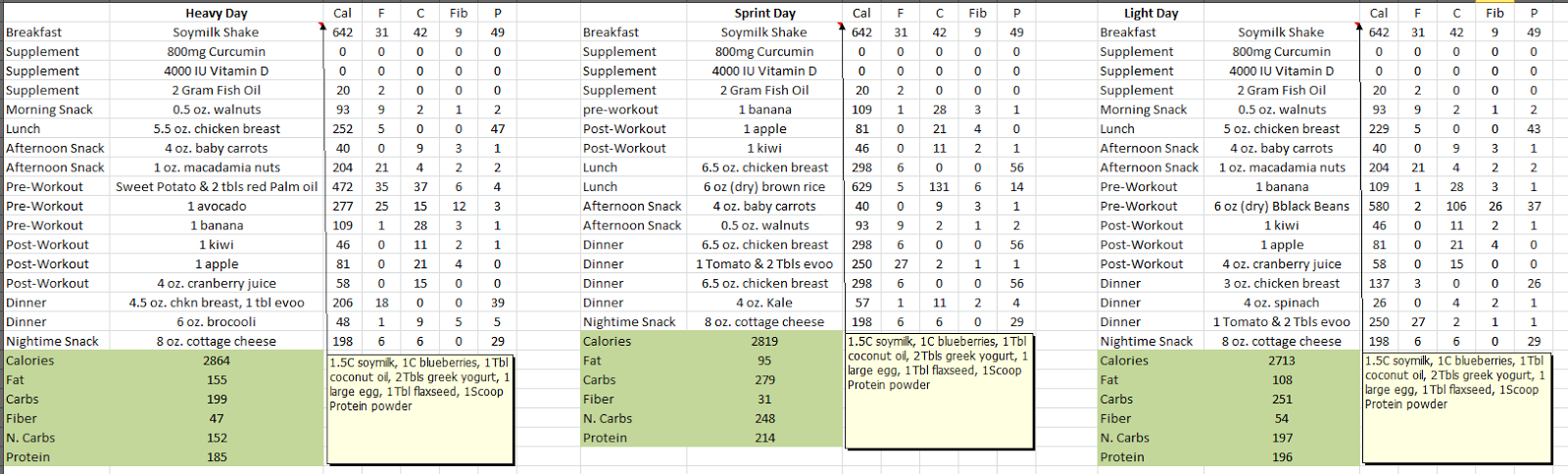
On my heavy days when I'm doing the low rep stuff I'll be getting about half my cals from fat, 25% from carbs, 25% protein, for the reasons stated above. On sprinting days I knock the fat back a bit and up the carbs a good deal; by the end I'm depleting glycogen like crazy, especially on the 200s. I also bump up the protein because of how much damage I'm inflicting on my posterior chain. On my 'light' day in the gym, which would be things between 5 and 8 rep sets, I'm going to be around 200g of carbs net, lower fat, and slightly higher protein since I'm inflicting a bit more muscle-trauma than on the heavy days. Here's how things like PUFAs (and omega-3s & oemga-6s), and fructose shook out, as well as what my targets were for each day for macros:

I got pretty close to what I wanted, and will get closer on PUFAs when I switch off of soy milk. Also, at the moment I'm at 1 oz. walnuts, no macadamia because I'm trying to find a cheaper source, they're expensive.
One final note: to speed up the cut I've cut the fat back from the levels here, I do either an avocado or the sweet potatoes on the heavy day, bringing me back to either 2200 or 2400 calories. As I get closer to my goal weight/comp I'll bring both back in. That's what I like about using so many oils here, if I need to cut back on calories later I can just reduce tablespoons of the stuff.
The results so far? Good. Really good. I'm down from 230 to about 210-212 right now. I've barely lost any strength, maybe none even. The shoulder tweaking prevented me from push pressing and snatching heavy for a while, but even there I haven't really lost a ton of strength. Squat, deadlift, benching, rows, all of it feels good. I look pretty good too, I'll post progress pictures soon. Another few weeks I should be really close to where I want to be, and I'm going to start running Hot-Rox soon (more on that in another post). Alright, I've rambled enough.
Having decided on that, I also didn't want a repeat of last year, when on my high-fat days I was probably close to 70g of polyunsaturated fats. Having read up and digested a great deal of information on the topic, which I summarized here for you. I want to keep it closer to 15g-20g this time around (I didn't quite get there, but I'm in range; I'll get closer if I swap out soy milk which has a ton of polyunsats, with regular milk, if I ever find a good local source).
Finally, as I noted, you don't need nearly as much protein as you think you do. I was somewhere between 225 and 250g per day last year, and a bunch of that was probably just getting converted to ammonia in my blood. No more of that. I have it capped a little over 210 on my sprinting days which are brutal, and then around 185-190 on my other days. Oh, and regarding fructose, I'm not that worried as my levels aren't that high this time around. I was probably close to 60g last cut on my high-carb days, not repeating that. This time I'm in the mid 30s, which is fine considering most of it is post-workout, which negates a lot of the issues with it. In the previous link I also talk about insulin sensitivity some, and note that between 100 and 200g carbs per day leads to the greatest amount of insulin sensitivity.
OK, enough talk, here's what I'm going with this time around:
On my heavy days when I'm doing the low rep stuff I'll be getting about half my cals from fat, 25% from carbs, 25% protein, for the reasons stated above. On sprinting days I knock the fat back a bit and up the carbs a good deal; by the end I'm depleting glycogen like crazy, especially on the 200s. I also bump up the protein because of how much damage I'm inflicting on my posterior chain. On my 'light' day in the gym, which would be things between 5 and 8 rep sets, I'm going to be around 200g of carbs net, lower fat, and slightly higher protein since I'm inflicting a bit more muscle-trauma than on the heavy days. Here's how things like PUFAs (and omega-3s & oemga-6s), and fructose shook out, as well as what my targets were for each day for macros:
I got pretty close to what I wanted, and will get closer on PUFAs when I switch off of soy milk. Also, at the moment I'm at 1 oz. walnuts, no macadamia because I'm trying to find a cheaper source, they're expensive.
One final note: to speed up the cut I've cut the fat back from the levels here, I do either an avocado or the sweet potatoes on the heavy day, bringing me back to either 2200 or 2400 calories. As I get closer to my goal weight/comp I'll bring both back in. That's what I like about using so many oils here, if I need to cut back on calories later I can just reduce tablespoons of the stuff.
The results so far? Good. Really good. I'm down from 230 to about 210-212 right now. I've barely lost any strength, maybe none even. The shoulder tweaking prevented me from push pressing and snatching heavy for a while, but even there I haven't really lost a ton of strength. Squat, deadlift, benching, rows, all of it feels good. I look pretty good too, I'll post progress pictures soon. Another few weeks I should be really close to where I want to be, and I'm going to start running Hot-Rox soon (more on that in another post). Alright, I've rambled enough.


